In interior design, lighting has always been the key to creating atmosphere. In recent years, free-cutting COB LED strip lights have rapidly replaced traditional strip lights and standard COB strips, thanks to their dot-free illumination, flexible cutting, and high adaptability. They’ve become a go-to choice in both residential and commercial projects.
From concealed ceiling lighting in modern no-main-light designs, to under-cabinet task lighting, and even ambient lighting in commercial spaces—you’ll find them everywhere. Some people call them an “overpriced gimmick,” while others praise them for “unlocking limitless lighting possibilities.”
Today, we’re going to uncover the full truth about free-cutting COB LED strip lights—from definition and comparisons to selection, installation, and maintenance. This guide will help you avoid common pitfalls, choose the right product, and truly understand why it has become a rising star in modern lighting design.
1. What Is a Free-Cutting COB LED Strip?
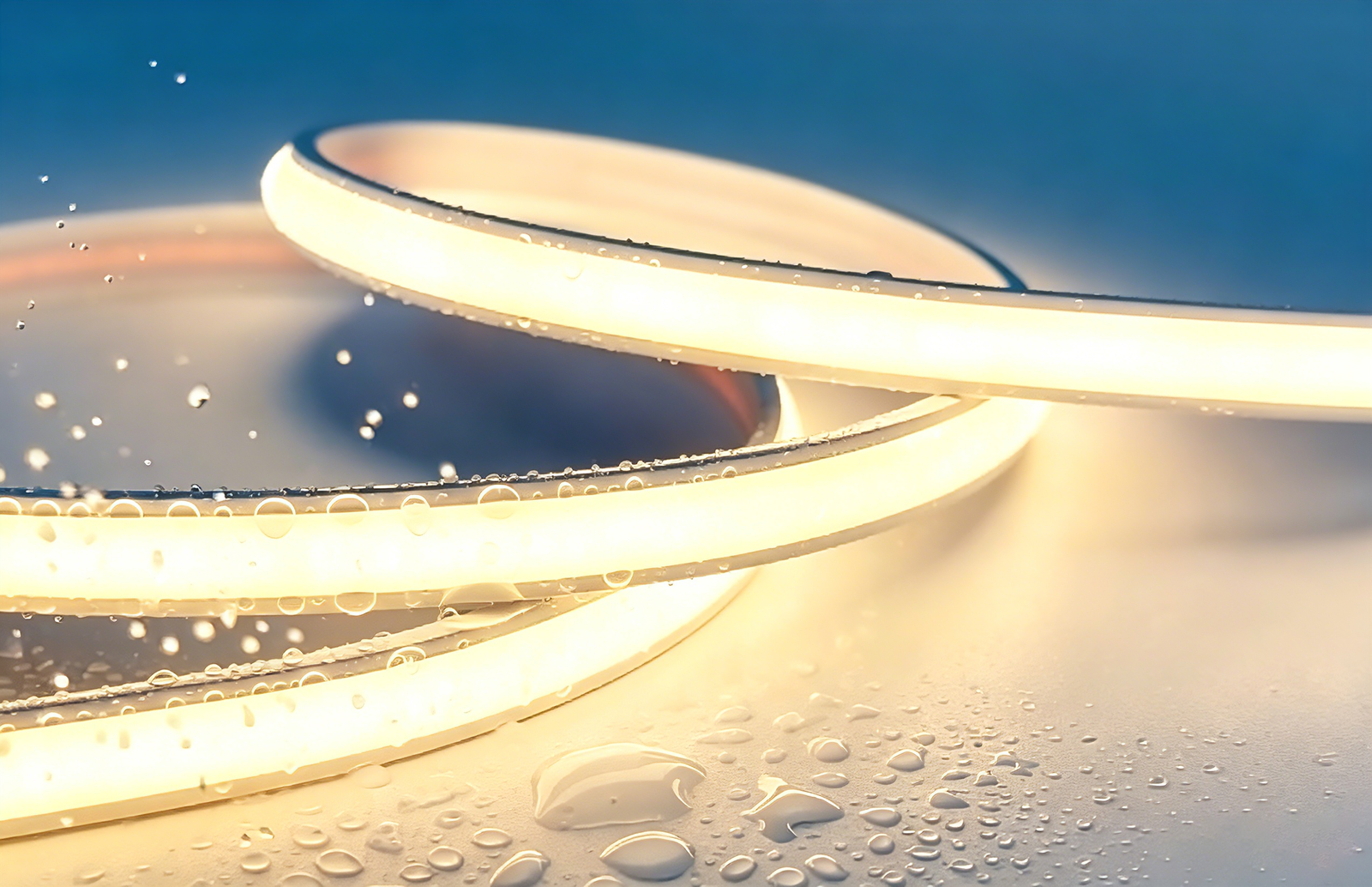
To understand a free-cutting COB LED strip, it helps to first know COB LED technology and the concept of cut-anywhere LED strips. A COB (Chip On Board) LED strip integrates multiple bare LED chips directly onto a flexible aluminum PCB, uniformly encapsulated with a phosphor layer to create a continuous, smooth line of light. Unlike traditional SMD LED strips, which produce individual dots of light, COB strips deliver dot-free linear illumination, providing a premium, seamless lighting effect for residential, commercial, and architectural projects.
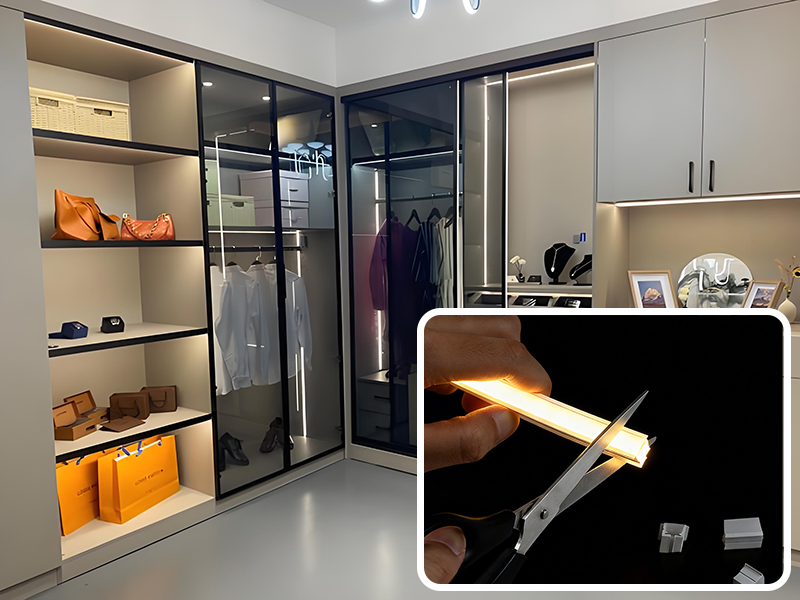
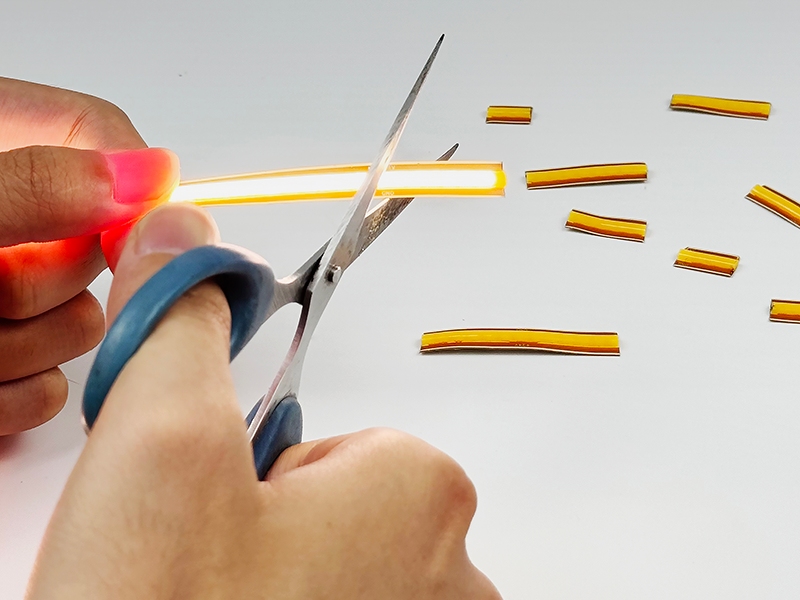
A free-cutting COB LED strip is an upgraded version of standard COB strips, designed for flexible LED lighting installation. Its core advantage is the ability to cut the LED strip at any position, rather than at fixed intervals like conventional COB strips. Even after trimming, the remaining section continues to operate normally, without dark spots or uneven light, making it ideal for customizable lighting layouts, irregular spaces, and complex interior designs.
With an ultra-thin profile of 0.5–1 mm, these flexible COB LED strips can bend, twist, and fit into narrow aluminum channels, coves, or tight architectural details. This combination of smooth, continuous lighting and maximum installation flexibility is why free-cutting COB LED strips are becoming a top choice for modern residential, commercial, and high-end architectural lighting projects.
2.Free-Cutting COB LED Strip vs Standard COB LED Strip
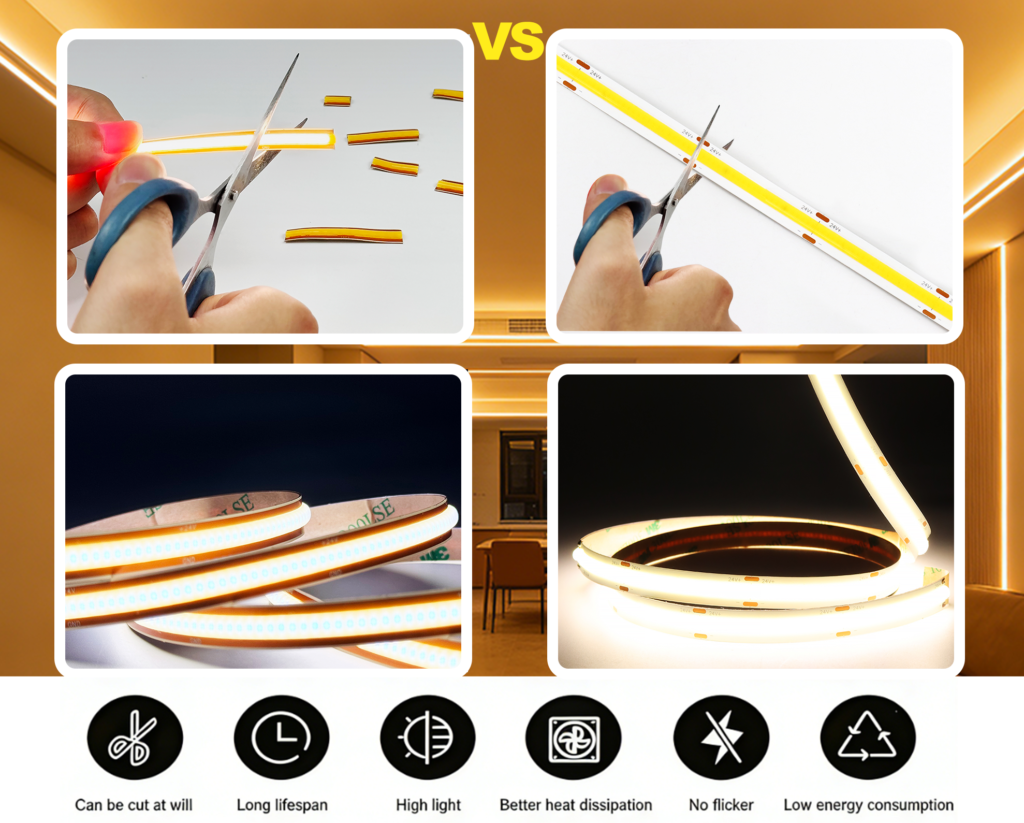
When choosing LED strips, understanding the differences between a free-cutting COB LED strip and a standard COB LED strip is crucial for installation efficiency, lighting quality, and overall cost.
Cutting Flexibility
- Free – cutting COB LED strip: Can be cut anywhere on the strip. The remaining part lights up normally, suitable for irregular spaces and custom – shaped lighting projects.
- Standard COB LED strip: Can only be cut at designated points; cutting elsewhere may damage the circuit.
Installation Efficiency
- Free – cutting: Cut on – site as needed, saving time and reducing waste, ideal for commercial installations.
- Standard COB: Needs precise pre – installation measurement and planning, increasing error risk and material loss.
Lighting Performance
- Free – cutting: Produces continuous, uniform light for a premium linear effect.
- Standard COB: May have voltage drop or uneven brightness, especially in long runs, reducing lighting quality.
Cost and Value
- Free – cutting: Slightly higher unit price but reduces labor and waste, offering better long – term value for high – end projects.
- Standard COB: Lower initial cost but higher installation complexity may increase total project expenses.
Conclusion:
For projects that demand flexible LED strip lighting, smooth linear illumination, and custom installation, a free-cutting COB LED strip outperforms standard COB LED strips in every aspect, making it the preferred choice for modern architectural lighting and sophisticated interior design applications.
3.How to Choose the Right Free-Cutting COB LED Strip (Beginner’s Pitfall Guide)
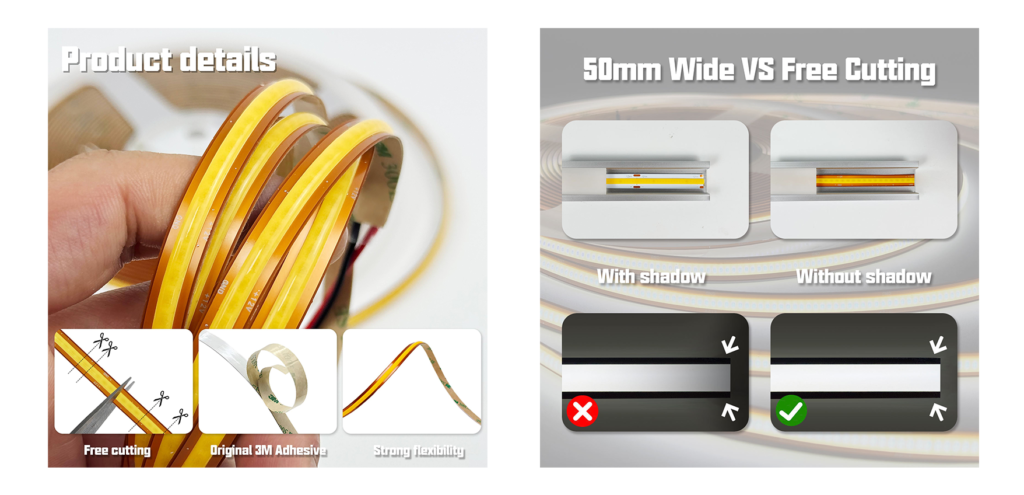
The market is full of free-cutting COB LED strips, with prices ranging from around $1–$5 per foot. Without careful selection, you might encounter misleading specifications, uneven light output, or severe light decay within months.
Here’s a simple beginner-friendly guide: focus on 4 core parameters and 2 practical tips, and you can confidently choose the right strip.
4 Core Parameters (Must-Check)
①Color Rendering Index (CRI/Ra)
Determines how accurately the light reproduces colors. Sunlight is 100 Ra. The higher the CRI, the truer the colors appear.
Home lighting: Ra ≥ 90
Makeup mirrors, art studios: Ra ≥ 95 to avoid color distortion (e.g., “lipstick color looks wrong”).
Watch out for fake CRI claims; prefer models with high R9 values for true red rendering.
②Color Temperature (CCT, K)
Determines the light “mood” or atmosphere. Use consistent color temperatures in the same space.
2200K–3500K (warm light): bedrooms, cozy areas
4000k-4500K (neutral light): kitchens, workspaces
6000K-6500k (cool white): study rooms, offices
③Voltage
Home use: 12V or 24V low-voltage strips are safer, ideal for kids’ rooms or living areas.
Large commercial projects: 24V recommended.
Avoid 220V high-voltage LED strips for safety reasons.
④IP Rating (Waterproof Level)
Choose according to installation environment:
Indoor dry areas: IP20
Damp areas (bathrooms, kitchens): IP44 or above
Outdoor: IP65 or above
2 Practical Tips to Avoid Pitfalls
①Choose flexible aluminum PCB over plastic
Aluminum improves heat dissipation, extending strip lifespan and preventing chip burnout.
②Avoid plastic substrates
Always request a sample to test light quality before bulk purchase.
Summary: Focus on CRI, color temperature, voltage, IP rating, and choose reputable brands with aluminum substrates, and even beginners can avoid common pitfalls when buying free-cutting COB LED strips.
4.Installation Steps for Free-Cutting COB LED Strip (Easy DIY, No Professional Electrician Required)
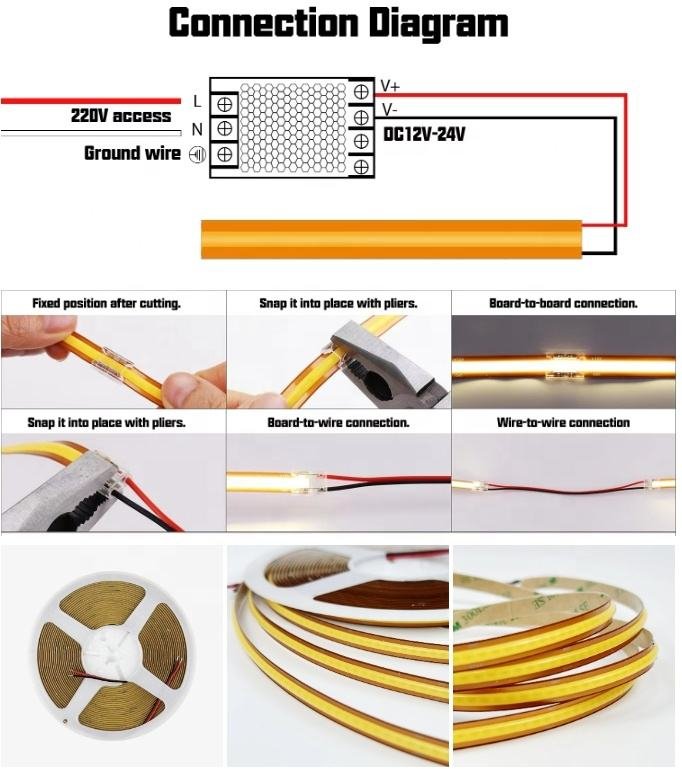
Installing a free-cutting COB LED strip is simple and beginner-friendly. The key is precise cutting, correct wiring, and proper fixing. Following these steps, you can complete a single area in about an hour. Always ensure safety precautions before starting.
Step 1: Measure and Cut
Measure the installation area and mark the cutting positions on the LED strip. Cut vertically at the marked points. After cutting, wipe the cut surface with a dry cloth. Beginners should leave an extra 0.2 cm margin to ensure proper connection.
Step 2: Prepare Tools and Materials
Tools: scissors, wire stripper, solderless connectors (or soldering tools), heat shrink tubes (or electrical tape), cable clips.
Materials: free-cutting COB LED strip, compatible power supply, aluminum channel (optional).
Step 3: Prepare the Installation Surface
Clean the surface thoroughly to ensure it is dry and flat. For outdoor or humid areas, apply waterproofing treatment beforehand.
Step 4: Wiring
Strip 1–2 cm of insulation from the end of the LED strip. Attach a solderless connector to the copper pads (or solder if preferred), making sure to match the positive and negative terminals. When connecting multiple segments, ensure polarity alignment and insulate the joints properly. For long runs, consider wiring from both ends to prevent voltage drop.
Step 5: Test
Before final installation, connect the power supply and test the strip to ensure it lights up correctly. It’s recommended to test 1 meter first.
Step 6: Fix and Route the Strip
Stick the LED strip to the installation area, optionally inside an aluminum channel for better heat dissipation. Use cable clips to organize wires, keeping them away from water and heat sources. Use L-shaped connectors for corners and bends.
Step 7: Final Check
After installation, power on the strip again to confirm everything works correctly. Once verified, the installation is complete and ready for regular use.
Tips:
For humid or outdoor environments, seal wiring connections with waterproof glue.
Avoid pulling or sharply bending the LED strip to prevent damage.
5.Free-Cutting COB LED Strip Applications: High-End Residential and Commercial Lighting Solutions
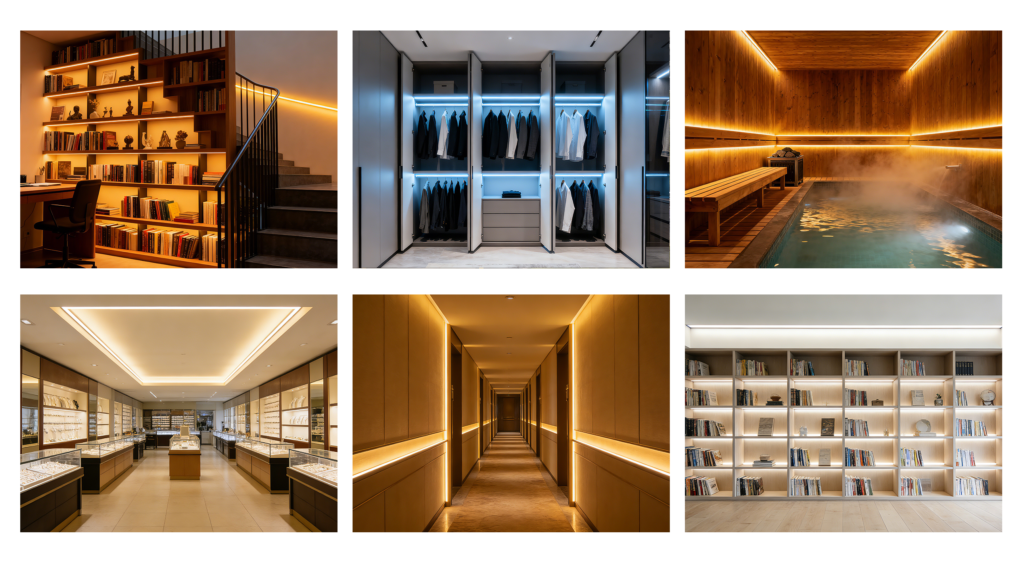
1. Residential Applications
- Under-cabinet lighting / Kitchen & Cabinet Free-Cutting COB LED Strip: Provides even illumination for kitchens, wardrobes, or bookshelves with no dark spots, and can be easily embedded into cabinets.
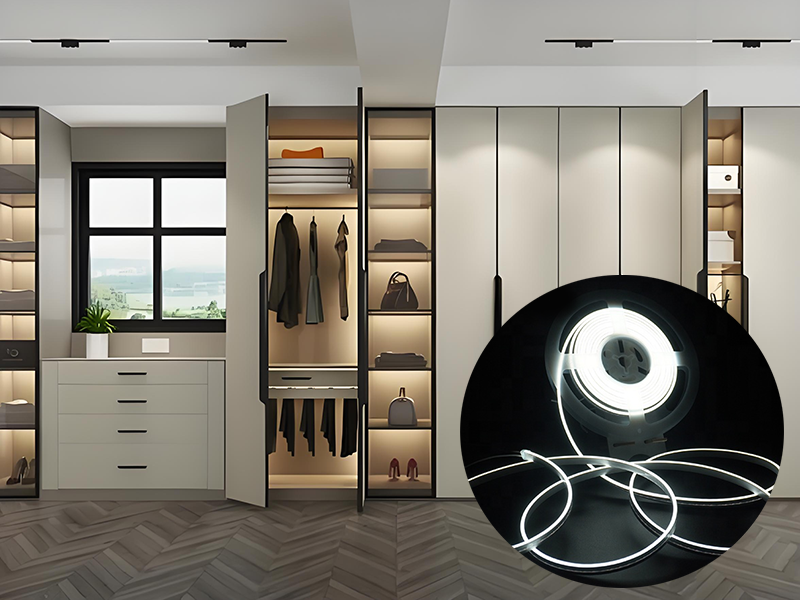
- Cove and ceiling ambient lighting / Living Room Free-Cutting COB LED Strip: Ideal for hidden installations in ceilings or walls, creating soft, glare-free linear lighting effects.
- Staircase and skirting lighting / Stairway Free-Cutting COB LED Strip: Enhances safety while adding modern style, suitable for homes and villas.
2. Commercial Spaces
- Display cabinet lighting / Retail Free-Cutting COB LED Strip: Offers uniform linear light to highlight product details, perfect for jewelry, cosmetics, and high-end retail stores.
- Mall guide lighting / Mall Free-Cutting COB LED Strip: Can be flexibly trimmed to run along stairs, ceilings, or walls, providing clear navigation and a comfortable atmosphere.
- Restaurant and hotel ambient lighting / Hotel Free-Cutting COB LED Strip: Combines warm or neutral light to enhance spatial quality, suitable for restaurants, bars, and hotel lobbies.
3. Architectural and Engineering Linear Lighting
- Building contour lighting / Architectural Free-Cutting COB LED Strip: Can be installed continuously along walls, ceilings, or building contours, improving nighttime visual impact.
- Conference rooms and office spaces / Office Free-Cutting COB LED Strip: Soft lighting reduces glare while improving comfort and visual aesthetics.
- Creative or irregular spaces / Custom Free-Cutting COB LED Strip: Can be cut to any length or shape, perfect for complex geometric designs and unique lighting layouts.
6. Extend the Lifespan of Free-Cutting COB LED Strips (Practical Tips to Save Money and Hassle)
High-quality free-cutting COB LED strips have a normal lifespan of over 50,000 hours (about 17 years if used 8 hours per day). Improper use can accelerate light decay and shorten their lifespan. Follow these 5 tips to make your LED strips more durable:
1.Ensure Proper Heat Dissipation: Install the LED strips in aluminum channels whenever possible. Use aluminum substrates for better heat conduction and keep the operating temperature below 60°C to prevent chip overheating and light decay. Avoid placing the strips in enclosed spaces where heat cannot escape, as this may damage the chips.
2.Avoid Overloading: Choose a power supply that matches the LED strip’s wattage. Using an underpowered supply can cause dimming, flickering, and faster aging. Limit single strips to no more than 10 meters to prevent voltage drop from affecting performance and lifespan.
3.Clean Correctly: Regularly wipe dust off the LED strip with a dry cloth. Avoid using a wet cloth to prevent short circuits. For strips in humid areas, check wiring insulation regularly and replace aging tape or heat shrink tubes promptly.
4.Minimize Frequent Switching: Turning the lights on and off frequently can wear out the chips. Use smart switches with timers or motion sensors to reduce manual switching.
5.Keep Away from Harsh Environments: Do not install LED strips in areas with high temperatures, high humidity, or corrosive gases. For outdoor use, select strips with high waterproof ratings and proper protection to prevent water or dust ingress.
7. FAQ (Beginners Must-Read, Avoid 90% of Pitfalls)
Q1: Can the remaining part of a Free-Cutting COB LED Strip be used after cutting?
A: Yes! This is one of its core advantages. After cutting at any position, the remaining part will work as long as the positive and negative connections are correct, with no dark spots or performance issues. When cutting, make sure to cut vertically to avoid damaging the internal circuitry.
Q2: Can Free-Cutting COB LED Strips be connected? Will connecting them affect the lighting?
A: Yes, they can be connected using solderless connectors or by soldering. Make sure to match the positive and negative terminals, and wrap the connection points with insulating material. High-quality strips maintain uniform brightness after connecting, without dark spots or gaps. Low-quality strips may have slight color differences, so it’s recommended to choose branded products.
Q3: Why does my Free-Cutting COB LED Strip become dim after a period of use?
A: There are usually two main reasons: ① Low-quality strips with poor chips, causing rapid light decay; ② Poor heat dissipation or incompatible power supply, leading to chip aging. It is recommended to choose branded LED strips, install them in aluminum channels, and use a suitable power supply.
Q4: Can Free-Cutting COB LED Strips be used in humid areas like bathrooms or balconies?
A: Yes, but you must select the appropriate waterproof rating (IP44 or above for bathrooms, IP65 or above for balconies). Also, ensure the wiring is insulated and waterproofed to prevent moisture from causing short circuits.
Q5: What happens if I connect the LED strip with reversed polarity?
A: The strip will not light up, but the chips will not be damaged. Simply correct the positive and negative connections to resume normal operation. It’s recommended to double-check the “+” and “-” markings before wiring to avoid mistakes.
Q6: What’s the difference between Free-Cutting COB LED Strips and RGB color-changing LED strips?
A: Free-Cutting refers to the “cutting method,” while RGB refers to the “light effect type.” They can be combined (i.e., RGB Free-Cutting COB LED Strip). Standard Free-Cutting COB strips produce single-color light, whereas RGB strips can switch between multiple colors, perfect for creating personalized lighting effects. RGB versions are slightly more expensive.
8. The Truth About Free-Cutting COB LED Strips: Why They Are the New Favorite in Home & Commercial Renovation
LED strip lights are widely used in home and commercial lighting. Free-cutting COB (Chip on Board) LED strips are gaining popularity for their flexibility and reliability. This article summarizes their advantages and provides selection tips.
Advantages of Free-Cutting COB LED Strips
1.Cut Anywhere
Can be cut at any point. Remaining parts work if positive and negative terminals are connected correctly.
2.Uniform Light
COB technology integrates multiple LED chips on a flexible board, producing continuous light without dark spots.
3.Easy Installation
Connect using solderless connectors or soldering. Match positive and negative terminals and cover joints with insulating material. High-quality strips maintain consistent brightness after connection.
4.Versatile Applications
Indoor: Living rooms, bedrooms, kitchens, wardrobes
Commercial: Display shelves, shop windows, bars, counters
Humid Areas: IP44+ for bathrooms, IP65+ for balconies or outdoor corridors
5.Single-Color
Standard strips offer single-color light
Selection Tips
Length: Choose based on space; leftover parts can be reused.
Waterproof Rating: IP20-IP44 for indoor, IP44-IP65 for humid or outdoor areas.
Color: Warm white, natural white.
Installation: Use aluminum channels for long strips to improve heat dissipation.
Quality: Use reliable brands like https://grilite.com/free-cutting-series/
Conclusion
Free-cutting COB LED strips provide flexible cutting, uniform light, and reliable installation. They are suitable for home and commercial applications.
https://grilite.com/free-cutting-series/ fit spaces precisely and simplify installation.