Skip to content
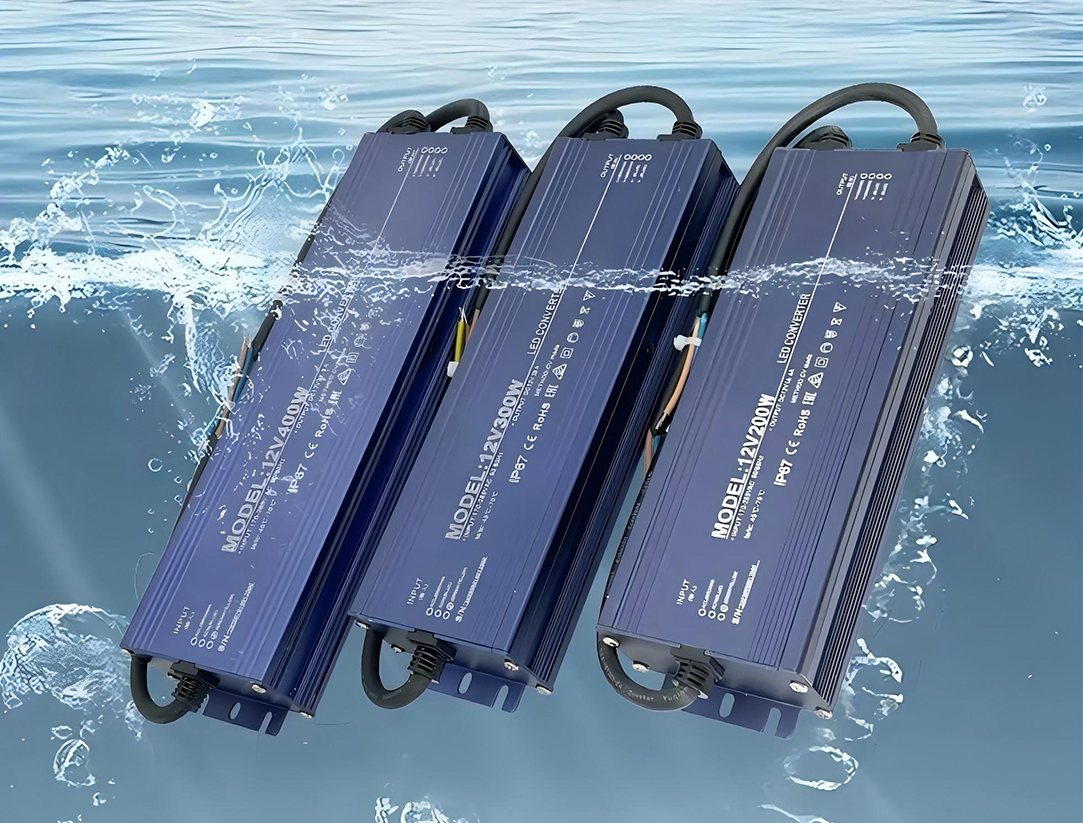
1.Why is LED power supply?
What is an LED Power Supply and Why It Matters
An led driver power supply, also called an LED driver, is a specialized device designed to deliver stable voltage or current to LED lighting. LEDs are semiconductor components that are extremely sensitive to current fluctuations, so using the right power supply is crucial. A quality LED driver converts standard AC mains power (e.g., AC 110V/220V) into a low-voltage DC output (e.g., DC 12V/24V) or a constant-current output, ensuring safe and efficient operation of LED fixtures.
In addition, reliable LED power supplies come with built-in protections against overvoltage, overcurrent, and short circuits, helping your LEDs maintain consistent brightness, reduce energy consumption, and achieve longer lifespans across different environments. Simply put, choosing the right LED power supply is essential for optimal lighting performance and safety.
2.Choosing the right LED power supply: what you need to know
In LED lighting systems, fixtures usually get all the attention—bright, efficient, and long-lasting. But the led light driver is just as important. The right power supply ensures proper performance, safety, and longer lifespan.
① Ensure Stable Performance
The power supply is the “heart” of your LED system, converting AC mains to stable DC output. A mismatched power supply can cause:
Low voltage → dim or uneven brightness
High voltage → overheating or damage
Unstable current → flickering
Example: A 24v led driver for a 12V strip can burn it instantly; a 12v led driver for a 24V strip will not light properly.
② Extend LED Lifespan
Poor-quality or incompatible power supplies generate excess heat, speeding up LED aging and reducing brightness. A properly matched power supply keeps LEDs working in optimal conditions.
③ Improve Safety
Incorrect power supplies can cause:
Overload and overheating
Short circuits or leakage in wet environments
Non-compliance with CE/UL safety standards
A reliable LED power supply protects both your lights and your home.
④ Enable More Lighting Features
Modern LED systems may require dimming or smart control.
Constant Voltage → LED strips
Constant Current → Chips / downlights
Dimmable Drivers → TRIAC / 0-10V / DALI / Smart
The right power supply ensures your LEDs work with all intended functions.
⑤ Reduce Long-Term Costs
A good power supply prevents frequent replacement, reduces energy waste, and lowers maintenance costs—making it a smart investment overall.
3.A Guide to the Basic Types of LED Power Supplies.
When choosing LED lighting, the power supply is often overlooked — yet it plays a critical role in brightness, safety, and lifespan. For beginners, understanding the two main types of LED power supplies is essential.
① Constant Voltage (CV) Power Supply
A constant voltage power supply provides a fixed output (e.g., 12V or 24V) while the current varies based on the load.
Best for: LED strips, modules, low-voltage lighting
Benefits: Easy installation, supports multiple strips
Key Tip: Power wattage must exceed the total LED load
Pro Tip: Check the LED strip label for “12V DC” or “24V DC”
② Constant Current (CC) Power Supply
A constant current power supply delivers a fixed current (e.g., 350mA, 700mA), with voltage adjusting automatically.
Best for: LED bulbs, downlights, spotlights, high-power fixtures
Benefits: Stable current, protects LEDs, extends lifespan
Key Tip: Match the rated current exactly to your LED fixture
③ How to Choose
LED strips → CV power supply
High-power fixtures → CC power supply
When unsure → Follow the manufacturer’s rating
Conclusion
Constant voltage is ideal for most LED strips, while constant current is designed for high-power LEDs. Choosing the correct type ensures safe operation, stable brightness, and long-lasting performance.
4.Ensure proper power and load matching
Power and Load Matching: How to Choose the Right led strip power supply
Many beginners overlook one key factor when choosing an LED power supply: matching the wattage with the LED load. An undersized power supply can cause flickering, overheating, and shorter LED lifespan, while a properly matched one ensures stable and efficient performance.
① Calculate Required Power
The power supply must meet or exceed the total wattage of the LED system.
Formula:
Power Supply Wattage ≥ Total LED Wattage
Example:
24V LED strip, 12W/m × 10m = 120W → choose ≥120W power supply
② Add a 20%–30% Safety Margin
This prevents overload and extends lifespan.
Example:
120W × 1.2 = 144W → a 150W 24V power supply is ideal
Benefits:
Less heat and stress on the power supply
More stable brightness and performance
③ Multiple Strips = Total Power Sum
Two strips (10m × 12W/m):
120W × 2 = 240W → choose ≥300W or use segmented power supply
④ Avoid Undersized Power Supplies
They cause:Flickering or dim output
Overheating and damage
Reduced LED lifespan
5.Pay attention to the output voltage and current specifications
Voltage & Current Compatibility: The Key to Choosing the Right LED driver Power Supply
One of the most common mistakes beginners make is ignoring voltage and current matching between the LED and the power supply led. Incorrect output can cause flickering, low brightness, or even permanent damage. Keep these essential rules in mind:
① Voltage Must Match Exactly
LED products specify a rated voltage such as 5V / 12V / 24V / 48V.
Too high voltage → LEDs burn out
Too low voltage → LEDs dim or fail to light
Examples:
24V LED strip → Use a 24V constant-voltage power supply
12V LED module → Use a 12V power supply
Never use 24V to drive a 12V LED — immediate damage!
② Current Matching Matters Too
Current depends on total LED wattage and voltage.
| Power Supply Type | Current Requirement | Typical Use |
| Constant Voltage (CV) | Ensure rated current ≥ LED demand | LED strips, modules |
| Constant Current (CC) | Must match LED rated current exactly | Downlights, spotlights, COB modules |
Current too high → overheating & shorter lifespan
Current too low → insufficient brightness
③ Higher Current ≠ Better Performance
More current does not make LEDs brighter.
Only correct matching ensures longer life and stable performance.
6.IP Waterproof Rating Selection Guide
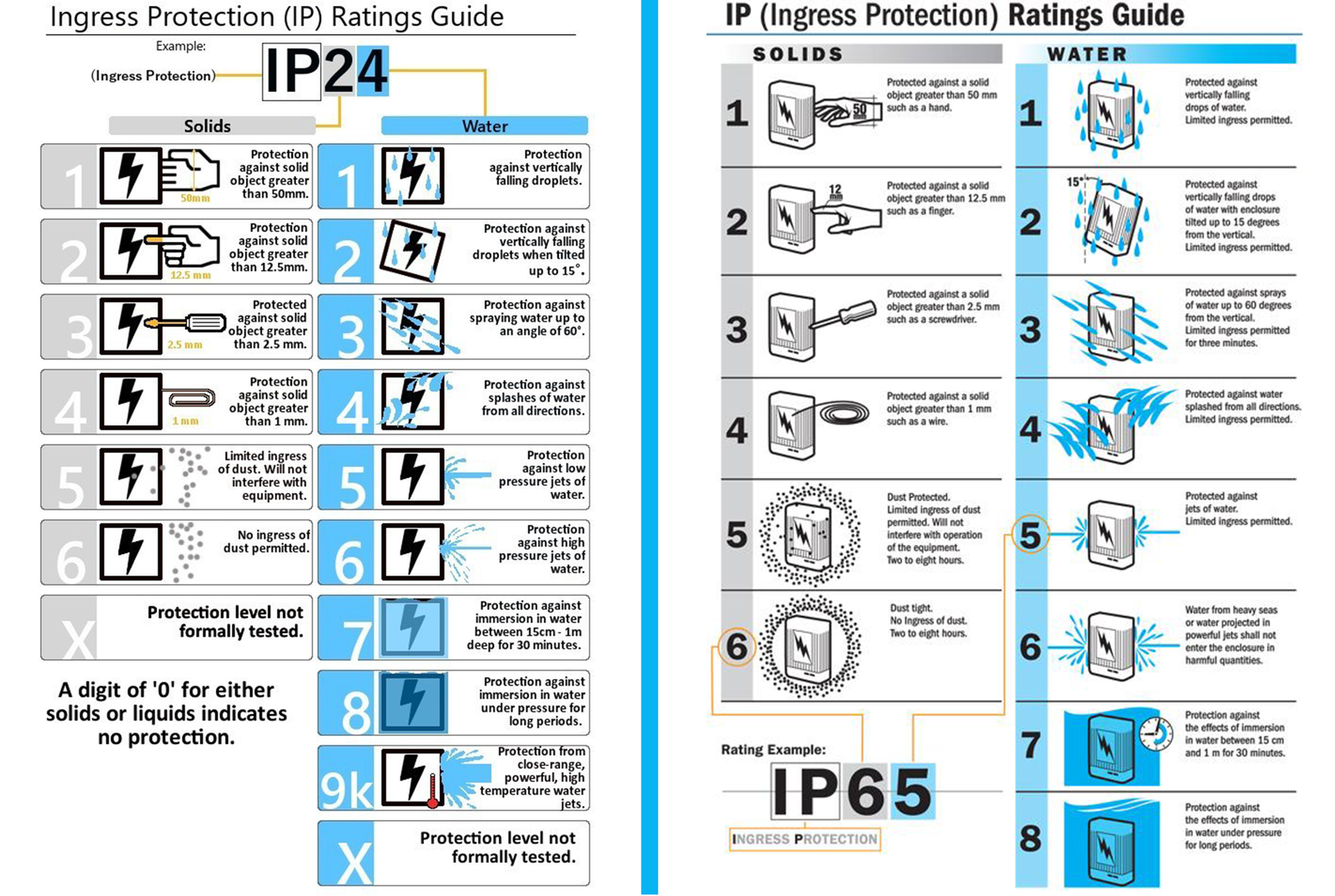
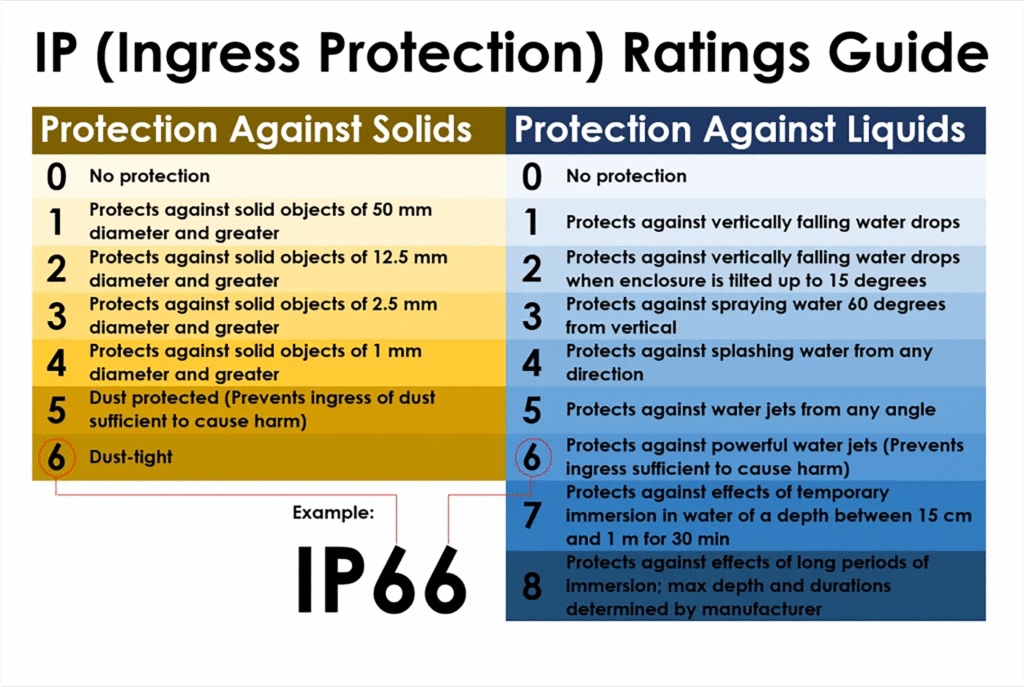
| IP Rating | Dust / Solid Protection | Water / Liquid Protection | Recommended Applications |
| IP20 | Protection from fingers or large solid objects (>12 mm) | Not waterproof | Dry indoor areas only (e.g., bedrooms, offices). Not suitable for damp places. |
| IP44 | Protection from small tools/wires (>1 mm) | Protection from water splashes from any direction | Bathrooms, kitchens, semi-outdoor areas with limited moisture |
| IP54 | Limited dust ingress protection | Water splashes resistant | Light outdoor use or dusty/wet environments (under shelter) |
| IP65 | Fully dust-tight | Protection from low-pressure water jets from any direction | Outdoor lighting, walls, roofs, garden lighting exposed to rain |
| IP66 | Fully dust-tight | Withstands high-pressure water jets | Harsh outdoor conditions, frequent heavy rain or washing |
| IP67 | Fully dust-tight | Short-term immersion in water (typically ≤1 m for ≤30 mins) | Landscape lighting, near-water installations, temporary submersion |
| IP68 | Fully dust-tight | Continuous immersion (depth & duration specified by manufacturer) | Underwater lighting, fountains, pools, marine lighting |
Different installation environments require different levels of waterproof and dustproof protection for LED power supplies, so choosing the correct IP rating is crucial. The IP (Ingress Protection) rating is defined by IEC international standards and indicates a product’s protection against the intrusion of solid objects and liquids.
An IP rating consists of two digits:
• The first digit represents the level of dust protection (0–6, with higher numbers indicating better dust resistance)
• The second digit represents the level of water protection (0–8, with higher numbers indicating better waterproof performance) Here is a comparison table of common IP ratings.
7.Dimming function supported

In modern lighting, users increasingly demand both lighting ambiance and smart control, and dimmable led driver play a key role in system compatibility. When selecting a power supply, it is essential to confirm whether it supports dimming and which dimming method it uses.
① Comparison of Common led dimmable driver Methods:
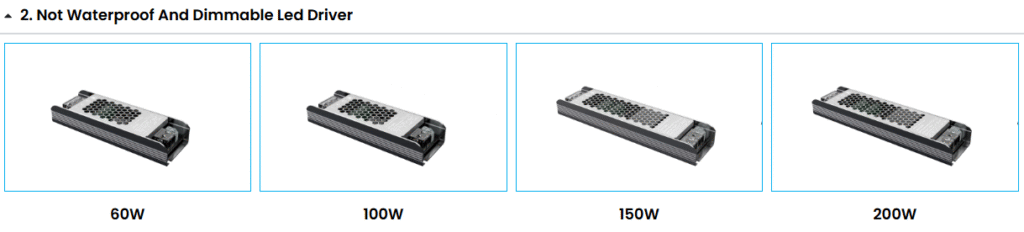
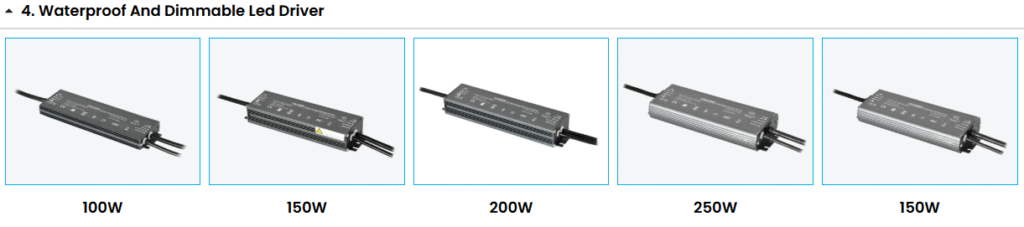
| Dimming Method | Required Power Supply Type | Advantages | Application Scenarios |
| TRIAC Leading/Trailing Edge | TRIAC dimmable power supply | Compatible with traditional wall dimmers | Residential lighting, hotels |
| 0-10V / 1-10V | 0-10V dimmable power supply | Stable system, simple wiring | Commercial, office, exhibition spaces |
| DALI | DALI dimmable power supply | Addressable control, precise dimming, supports group management | High-end commercial/building lighting |
| PWM Dimming | PWM dimmable power supply | Smooth dimming, suitable for LED strips | Home ambiance lighting, backlighting |
| Smart Dimming (WiFi / Zigbee / Bluetooth / RF) | Smart dimmable power supply or controller combo | Mobile/voice control, compatible with smart home systems | Smart home systems |
② Comparison of Common Non-Dimmable LED Power Supply Methods
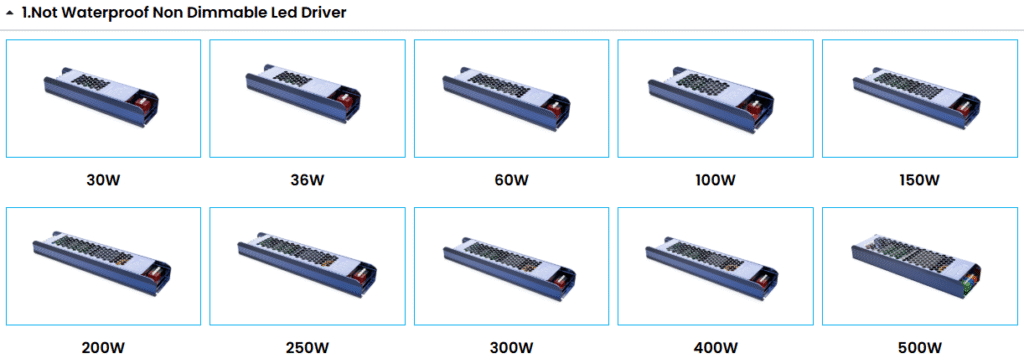
| Power Supply Method | Applicable Power Types | Typical Applications | Advantages | Disadvantages | Key Takeaways |
| Constant Voltage (CV) | 12V / 24V | LED strip lights, LED modules, low-voltage cabinet lighting | Easy wiring, great compatibility | Current limitations can be overlooked; overload may cause overheating or strip damage | Most common solution, ideal for strip lighting |
| Constant Current (CC) | 350mA / 700mA / 1500mA, etc. | LED downlights, spotlights, COB light sources | Stable brightness, extends LED lifespan | Requires precise matching; incorrect connection can burn LEDs | Enhances reliability and lifespan |
| Built-in Driver | Integrated driver inside the fixture | LED panel lights, bulbs, track lights | Clean look, fast installation | Hard to repair and higher replacement cost | All-in-one design, widely used by consumers |
| Driverless / AC Direct | AC 110V / 220V direct drive | 110V/220V LED strip lights, localized lighting | Simple wiring, low cost, long-distance power supply | Higher EMC requirements, weaker dimming compatibility | Popular in high-voltage strip lighting and signage |
| AC/DC Plug-and-Play Adapter | Wall-plug or desktop power supply | Small decorative lights, DIY projects | Plug-and-play, safe and convenient | Lower power rating, slightly less reliable | Best choice for home DIY beginners |
8.Safety and Certification Issues


Safety First: Choosing a Reliable LED Power Supply
For led light power supply, safety is paramount, especially in commercial, municipal, or export projects. A well-designed, certified power supply ensures stable operation and project approval.
① Core Protection Functions
A reliable power supply should include:
| Protection | Function | Prevents |
| Overvoltage (OVP) | Shuts off when voltage is too high | Lamp damage, smoke |
| Overcurrent (OCP) | Limits or cuts off excess current | LED overload |
| Short-Circuit (SCP) | Activates protection during shorts | Fire, power supply damage |
| Overtemperature (OTP) | Reduces power or shuts off when hot | Accelerated aging, failure |
② Lifespan & Thermal Design
Typical lifespan: 30,000–50,000 hours, depending on heat dissipation
Aluminum case: Better cooling, suitable for outdoor use
Plastic case: Cost-effective, suitable for indoor use
High-quality chips and capacitors extend life
Every 10°C rise in temperature halves lifespan → ensure proper ventilation
③ Certifications for Export & Projects
Common certifications: CE (EU), UL/ETL (North America), FCC (US), RoHS (global), UKCA (UK)
Lack of certification can lead to: project approval issues, customs clearance problems, and higher safety risks
9.Installation and Safety Instructions
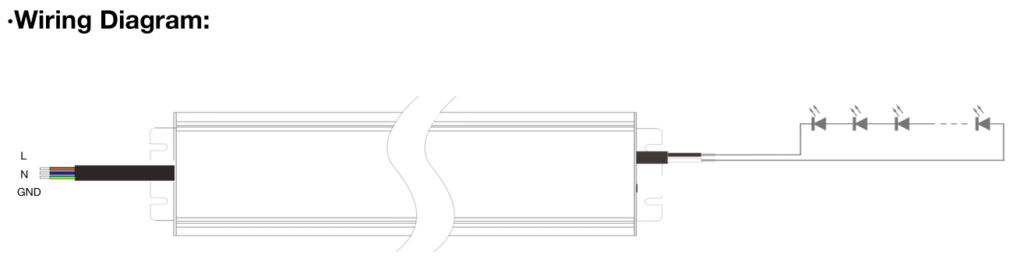
Even with the correct led light driver, improper installation can cause flickering, brightness decay, or overheating. Follow these key points during installation:
① Ensure proper heat dissipation
Avoid enclosed spaces, insulation, direct sunlight, or heat sources.
Leave at least 20 cm ventilation around the power supply.
Good ventilation = longer lifespan & stable brightness.
② Minimize voltage drop
Keep wiring short and use thicker cables.
Consider dual-end or segmented power supply led light strip, or power amplifiers if needed.
③ Use compatible connectors and waterproofing
Indoor: standard terminals suffice.
Humid/outdoor: waterproof connectors and sealed sleeves.
Buried/underwater: IP68 junction boxes or gel sealing.
Connectors are the main risk for short circuits.
④ Follow power distribution principles
Avoid overloading a single circuit for multiple strips.
Divide zones for consistent brightness and easier maintenance.
For dimming systems, check wiring direction and distance.
⑤ Check polarity
Constant voltage: red = +, black = –
Reversing polarity can prevent lighting or damage the controller.
Always turn off power before wiring and verify connections.
Summary: Proper installation ensures safety, stable performance, and longer LED life. Focus on heat dissipation, waterproofing, voltage drop, connector reliability, and correct polarity.
10.LED Power Supply Applications
In LED lighting systems, the power supply is a key component that affects brightness, safety, and lifespan. Different lighting scenarios have different requirements for the power supply, such as waterproof rating, power specifications, and dimming methods. Choosing the wrong one can not only cause flickering or reduced brightness but may also create safety hazards. Below, we’ll walk you through how to quickly select the right led strip driver based on common application scenarios.
①Waterproof Dimmable LED Power Supply
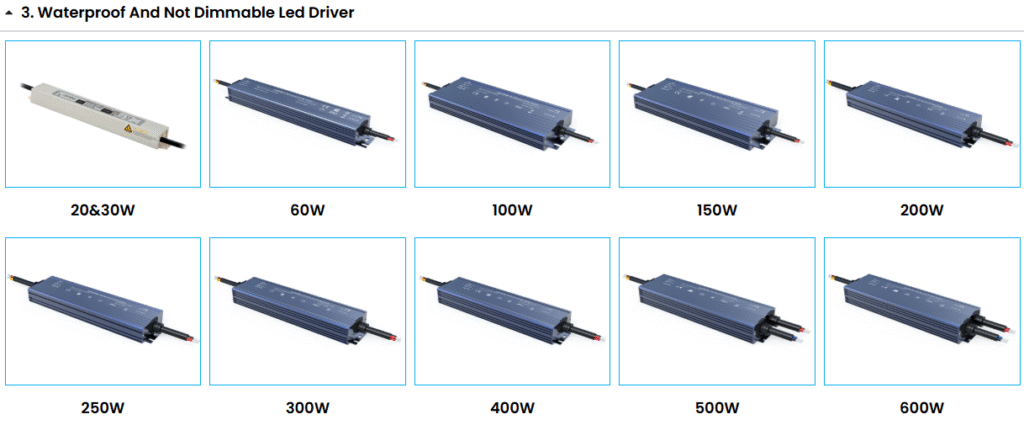
②Waterproof Non Dimmable LED Power Supply
③LED Cabinet Lighting Power Supply
11.Buying Guide and Product Recommendations

Once you understand the basics—voltage, current/power, and IP rating—the next step is to choose a reliable LED power supply suitable for your application and fixture type.
① Key Points When Choosing an LED Power Supply
Voltage matching: 12 V strips → 12 V supply; 24 V strips → 24 V supply.
Power margin: Select a supply at least 20% higher than total LED load to prevent flickering, overheating, or reduced lifespan.
IP rating: For humid or outdoor environments, choose IP65/IP67 or higher.
Dimming/control: If needed, pick a supply that supports dimming or is compatible with your controllers.
Safety & cooling: Ensure overvoltage, overcurrent, short-circuit protection and good heat dissipation.
② Recommended LED Power Supplies
Cost-effective, versatile options for 12 V / 24 V LED strips or fixtures. Choose based on total load, waterproofing, outdoor use, and dimming needs.
12.Conclusion
Choose the Right led tape light power supply for Safer, More Reliable Lighting
Selecting the right LED power supply may seem tricky for beginners, but focusing on voltage, current, power margin, and protection rating can prevent most installation and usage issues. The right power supply ensures stable brightness, longer lifespan, and safer operation.
If you’re unsure which model to choose, contact us for professional advice, recommended power supplies, and control solutions. You can also request quotes or sample testing to get your lighting project running reliably from the start.