Skip to content

1.Why is it so important to install high-voltage LED strips safely?
High-voltage 220V 110v led strip lights operate by connecting directly to the main power supply. Compared with low-voltage 12V / 24V LED strips, they carry higher electrical energy, which means that any installation mistake can lead to significantly greater safety risks. Proper installation is not only essential for the performance and lifespan of the strip, but also for personal safety, electrical safety, and system reliability.
First, there is a risk of electric shock. Because high-voltage LED strips are connected directly to AC mains power, incorrect wiring, non-compliant power plugs, poor insulation, or installing the strip while the power is on can result in serious electrical hazards. This risk is especially critical in residential, commercial, and public spaces.
Second, improper installation can cause short circuits and overheating. Loose connections, cutting the strip at non-designated points, or inadequate heat dissipation may lead to localized overheating. Over time, this can cause flickering, premature failure, damage to internal components, or even pose a potential fire hazard.
Third, safe installation directly affects the long-term stability and reliability of high-voltage LED strip lighting systems. Exceeding the recommended maximum length, failing to use a dedicated rectifier plug, or selecting an incorrect IP rating can result in voltage instability, uneven brightness, and accelerated degradation, increasing maintenance and replacement costs.
In addition, when high-voltage LED strip lights are used in outdoor or humid environments, insufficient attention to waterproofing and IP protection can allow moisture to penetrate the strip. This may lead to leakage currents, corrosion, or electrical failure, further increasing safety risks.
For these reasons, safe installation of high-voltage LED strip lights is not optional—it is essential. Only with correct product selection, proper wiring, adequate insulation, and appropriate environmental protection can 220v/110v led lights deliver their full advantages, such as long-distance operation, simplified wiring, and stable, reliable lighting performance.
2.What is a high-voltage LED strip for 110V / 220V mains?
A high-voltage 110v/220v light is an LED strip that can be connected directly to the mains power (AC 110V or 220V) without requiring an external low-voltage power supply.
Compared to common low-voltage LED strips (12V / 24V), high-voltage LED strips offer longer installation lengths, simpler wiring, and lower system cost for large-scale or continuous lighting applications.
1. How It Works
High-voltage LED strips are designed with built-in rectifier and current-limiting circuits that convert AC mains power into a form suitable for driving LEDs directly.
Because of the high operating voltage:
No external transformer or low-voltage driver is required
Installation is simpler, especially for long runs
Voltage drop is significantly reduced compared to 12V / 24V systems
2. Main Types of High-Voltage LED Strips
SMD High-Voltage LED Strip

Uses common LED packages such as 3528, 5050, 2835
LED chips are evenly spaced along the strip
Suitable for general lighting, decorative lighting, and commercial applications
COB High-Voltage LED Strip

Uses Chip-on-Board (COB) technology with LEDs mounted directly on the PCB
Produces continuous, uniform light with no visible dot effect
Ideal for linear lighting, ambient lighting, under-cabinet lighting, and architectural details
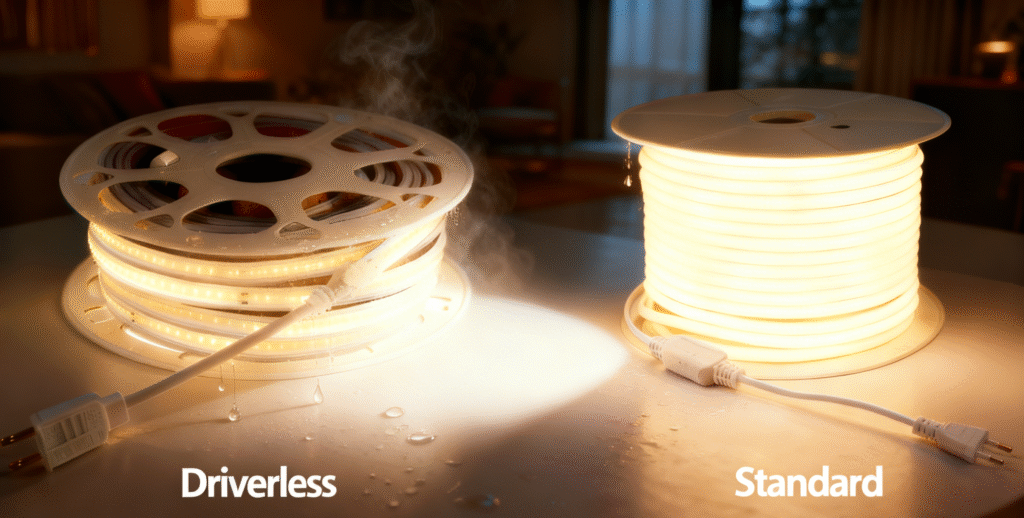
3. Driverless vs. Conventional High-Voltage LED Strips (with Control Module)
High-voltage LED strips can be further divided into driverless (no-driver) types and conventional high-voltage types with a control module.
Driverless High-Voltage LED Strip (with Control Module)
No external power supply or controller required
Connects directly to AC mains power
Simpler structure and fewer components
Lower overall system cost
Commonly used for basic on/off lighting applications
Conventional High-Voltage LED Strip (with Control Module)
Includes a built-in or inline power control module
Provides better current regulation and improved stability
Supports additional functions such as dimming or enhanced protection
Suitable for projects requiring higher performance and longer lifespan
4. Differences Between High-Voltage and Low-Voltage LED Strips
| Feature | High-Voltage LED Strip (110V / 220V) | Low-Voltage LED Strip (12V / 24V) |
| Power Supply | Direct connection to mains | Requires external transformer/driver |
| Installation Length | Long continuous runs possible | Limited by voltage drop (typically <5–10m) |
| Safety | Higher shock risk; strict safety standards required | Safer due to low voltage |
| Cost | Saves transformer cost | Additional power supply increases system cost |
| Typical Applications | Corridors, backlit walls, outdoor waterproof lighting | cabinets, furniture, display cases, precision lighting |
5. Advantages and Safety Considerations
Advantages
Simple installation without external power supply
Supports long, continuous lighting runs
Uniform, seamless lighting for both decorative and functional use
Ideal for commercial and architectural lighting projects
Safety Considerations
High-voltage operation requires strict compliance with electrical safety standards
Only cut the strip at clearly marked cutting points
Proper insulation, waterproofing, and grounding are essential
Professional installation is recommended for outdoor or commercial use
3.Key Safety Considerations to Know Before Installation

Before installing 110V or led strip lights 220v, it is crucial to understand and follow key safety precautions. Proper preparation ensures not only the longevity of the LED strips but also the safety of installers and end-users.
1. Verify Input Voltage and Regional Standards
High-voltage LED strips are designed for either 110V or 220–240V power supplies.
North America and parts of Asia typically use 110v lights, while Europe and most Asian countries use 220–240V.
Using the wrong voltage can cause 220v/110v led strip failure, overheating, or even fire hazards.
Always confirm that the LED strip voltage matches your power supply before installation.
2. Choose Certified LED Strip Products
Prioritize LED strips with UL, ETL, CE, or RoHS certifications.
Certified products have undergone safety, electrical, and environmental testing, making them suitable for commercial or industrial projects.
Avoid uncertified or low-cost counterfeit products, which significantly increase the risk of electric shock, short circuits, or fire.
3. Inspect Insulation and Structural Design
Silicone or PVC coatings provide protection against electric shock and enhance water resistance.
Ensure the PCB copper thickness and insulation layers meet high-voltage requirements.
Check for visible damage, cracks, or exposed copper wires before installation. Exposed wires can be extremely dangerous when connected to mains voltage.
4. Confirm a Safe Installation Environment
IP20 LED strips are suitable for dry indoor environments.
For damp or outdoor installations, choose IP65 / IP67 / IP68 rated waterproof strips.
Avoid installing directly on flammable or heat-sensitive surfaces, and ensure proper heat dissipation.
Outdoor installations should use waterproof connectors and additional sealing to prevent water and dust ingress.
5. Avoid Common Wiring Mistakes
Correctly identify L (Live) and N (Neutral) wires; never reverse polarity.
Use conductors rated for the strip’s current and compatible connectors; never use temporary or substandard wiring.
For longer installations, adopt segmented power distribution instead of connecting multiple strips in series, preventing excessive current buildup and overheating.
Tip for SEO & readability: You can add a small infographic showing proper wiring, IP rating comparison, and certified label examples to make this section visually engaging for readers.
4.Correct Wiring for 110V / 220V High Voltage LED Strips

1. Know the Wires
L (Live / Phase): Carries AC power
N (Neutral): Completes the circuit
PE / Ground (optional): For metal housings or safety
Incorrect wiring can cause electric shock or fire.
2. Prepare Before Wiring
Turn off the power completely.
Check strip terminals: Look for L / N labels.
Use proper tools & wires:
Wire ≥ 0.75mm² (adjust for length/power)
Fireproof, waterproof connectors recommended
3. Single Segment Wiring
1. Identify wires:
Red/Brown → L
Blue → N
Yellow-Green → Ground (if available)
2. Secure connections:Use screw terminals or quick connectors.
3. Insulate:Heat shrink tubing or insulation sleeves.
4. Test:Briefly power on to check brightness & safety.
4. Multiple Segments Wiring
①Use parallel power supply to prevent voltage drop and overheating.
②Segment rules:
Each segment gets separate mains connection (via junction box).
Avoid long single-end feeding.
Waterproof strips:Apply extra protection at connections (heat shrink + waterproof adhesive.
5. Safety Tips
①Never insert bare wires into sockets.
②Ensure proper grounding, especially outdoors or in wet areas.
③Check L/N polarity; reversed wires may affect dimming or controllers.
④Use switches and RCD/GFCI for extra protection.
⑤Avoid overly long series connections; split power for long runs.
5.Heat Dissipation and Mounting Requirements for High-Voltage LED Strip Lights
High voltage 110V / 220V LED lights generate continuous heat during operation. As these products are directly connected to mains power and operate at higher electrical loads, improper heat dissipation or insecure mounting can lead to overheating, accelerated lumen depreciation, insulation aging, and potential safety risks. Proper thermal management and standardized mounting methods are essential to ensure long-term, stable, and safe operation.
1. Thermal Characteristics of High Voltage LED Strip Lights
* High voltage LED strips typically use series or rectified high-voltage circuits, resulting in higher operating voltage per unit length
* During long-term continuous operation, heat can easily accumulate locally
* Poor heat dissipation directly affects LED lifespan, light output stability, and overall electrical safety
2. Recommended Heat Dissipation Methods
①Aluminum Profile Installation
Aluminum profiles provide excellent thermal conductivity and are strongly recommended for high voltage LED strips.
Benefits include:
* Lower operating temperature
* Reduced lumen depreciation and color shift
* Improved reliability and professional installation quality
②Adequate Air Circulation
Sufficient ventilation should be maintained around the 110v/220v ac led light.
Fully enclosed or non-ventilated installations are not recommended, especially for long continuous runs.
3. Heat Dissipation Methods Not Recommended (High Risk)
* Tight coiling or overlapping of LED strips
* Installation on or covering with thermal insulating materials such as wood, foam, or fabric
* Direct mounting on flammable or heat-sensitive surfaces
* Using adhesive-only mounting for high-power or long-duration applications without additional heat dissipation measures
4. Mounting and Fixing Requirements
①Mechanical Fixing Is Preferred Over Adhesive-Only Mounting
* Use aluminum channels, mounting clips, brackets, or dedicated holders
* Adhesive backing should only serve as auxiliary fixation, not as the primary mounting method
②Avoid Tension and Stress Concentration
* Leave slack at connection points and corners
* Prevent damage to solder joints or connectors caused by thermal expansion and contraction
③Corners and End Treatments
* Do not force sharp bends
* Use flexible jumpers or dedicated corner accessories when changing direction
5. Additional Requirements for Outdoor and Harsh Environments
* Outdoor installations must consider both heat dissipation and waterproof protection
* Silicone-encapsulated or waterproof LED strips still require proper thermal management
* Aluminum profiles combined with waterproof LED strips are recommended for outdoor projects
* In high ambient temperature or direct sunlight conditions, shorter installation lengths per run are advised
6. Professional Recommendation
Proper thermal design and secure mounting not only extend the service life of high voltage LED strip lights but also significantly reduce safety risks. For commercial lighting, architectural outlines, and outdoor lighting projects, a standardized installation approach combining aluminum profile heat dissipation and mechanical fixing is strongly recommended to ensure reliable long-term performance.
6.Safety Installation Recommendations for High Voltage (110V/220V) LED Strips in Different Applications

1. Outdoor Building Contours, Patios, and Garden Lighting
①Environment Characteristics: All-weather exposure, rain, snow, sun
②Safety Recommendations:
* Choose IP65/IP67 strips, or IP68 for submerged or extreme conditions
* Apply secondary waterproofing for connectors and segment joints
* Use UV-resistant materials to prevent cracking under sunlight
* Use segmented power supply to avoid overheating due to single-end power feeding
* Surge protection devices (SPD) are recommended to protect against lightning or voltage spikes
2. Commercial Spaces and Display Window Lighting
①Environment Characteristics: Long operating hours, continuous lighting, visual effects required
②Safety Recommendations:
* Use high voltage strips with CE/UL/ETL certifications
* Install strips in metal or aluminum channels for heat dissipation
* Limit segment length to prevent excessive current and localized overheating
* Regularly inspect connectors and mounting components for long-term stability
3. Large Outdoor Decorations and Festival Lighting
①Environment Characteristics: Large span, exposed to weather, continuous operation
②Safety Recommendations:
* Use segmented power supply, each segment with independent power and waterproof connectors
* IP67/IP68 strips with additional sealing at critical connections
* Use high-quality connectors and cables to support long-distance current
* Consider wind and snow load on strips and mounting components
* Use timers or controllers to prevent overheating from prolonged operation
4. Special Applications: Water Features and Poolside Lighting
①Environment Characteristics: Long-term submersion or proximity to water
②Safety Recommendations:
* LED strips must be IP68 rated for full waterproof protection
* Wiring points must be above water level or use dedicated underwater connectors
* Strictly follow high-voltage safety standards; consider isolation transformers if necessary
* Regularly inspect waterproof seals to prevent water ingress and short circuits
5.Summary:
The key safety considerations for high voltage LED strips vary by application but generally focus on waterproof rating, correct wiring, segmented power supply, heat dissipation, and secure mounting. Adjust strip rating and installation methods based on humidity, continuous operation, or exposure conditions to ensure long-term safe performance.
7. Common Installation Mistakes and Risk Analysis for 110V / 220V High-Voltage LED Strips
1. Directly Connecting Bare Wires to Mains
①Example: Stripping the ends of the LED strip wires and inserting them directly into the power supply or fixing them with screws.
②Risk Analysis:
* High risk of electric shock
* Short circuits or fire hazards
* Violates electrical safety standards
③Correct Approach: Use proper terminal connectors or waterproof quick connectors and ensure all wires are properly insulated.
2. Directly Connecting Multiple LED Strips in Parallel
①Example: Connecting several strips end-to-end without considering the maximum length or load limit of a single strip.
②Risk Analysis:
* Excessive current causing PCB overheating
* Reduced lifespan of LEDs
* Potential overload or damage to the power supply
③Correct Approach: Follow the manufacturer’s recommended maximum length, and use segmented power distribution if necessary.
3. Ignoring Polarity
①Example: Connecting live (L) and neutral (N) wires incorrectly or without checking polarity.
②Risk Analysis:
* Certain high-voltage LED strips may be damaged
* Increased risk of electric shock
③Correct Approach: Always follow the LED strip markings and verify polarity before powering on.
4. Using Low IP-Rated Strips in Wet or Outdoor Environments
①Example: Installing an IP20 strip outdoors or in a humid area such as a kitchen.
②Risk Analysis:
* Water ingress causing short circuits
* Risk of casing damage and electric shock
* High potential for safety incidents
③Correct Approach: Select a strip with an appropriate IP rating (IP65/IP67/IP68) and ensure proper sealing.
5. Installing on Heat-Sensitive Surfaces or Covering the Strip
①Example: Mounting the LED strip directly on wood, plastic, or fabric surfaces without ventilation.
②Risk Analysis:
* LED strip overheating, reducing lifespan
* Potential fire hazards
③Correct Approach: Use aluminum profiles or leave sufficient space for heat dissipation, and avoid covering flammable materials.
6. Using Incompatible Dimmers or Controllers
①Example: Connecting a non-dimmable high-voltage strip to a standard Triac dimmer.
②Risk Analysis:
* Flickering or abnormal heating of the strip
* Damage to the dimmer or strip
* Increased electrical safety risks
③Correct Approach: Use dimmers or 110v led controller remote recommended by the manufacturer for high-voltage LED strips.
7. Operating or Testing Without Power Off
①Example: Adjusting wiring or cutting the strip while it is powered.
②Risk Analysis:
* Extremely high risk of electric shock
* Possible damage to the LED strip or power supply
③Correct Approach: Always disconnect the power before installation, cutting, or maintenance, and use insulated tools during testing.
④Summary:
The safety of high-voltage strip led 110v/220v installation directly affects both product longevity and personal safety. Following key principles such as proper wiring, waterproofing, avoiding overload, ensuring good heat dissipation, and using compatible controllers can effectively prevent the risks associated with common installation mistakes.
8.Professional Maintenance & Safety Guide for 110V 220V High Voltage LED Strips
High voltage 110v/220v led strip offer the convenience of long-distance power supply and simplified installation, making them ideal for commercial lighting, architectural accents, and outdoor applications. However, unlike low-voltage LED strips, they carry higher electrical risks. Proper maintenance and safe usage are critical to ensure reliable operation, extend lifespan, and prevent hazards such as short circuits, overheating, or fire.
Daily Usage Precautions
To maintain optimal performance, avoid overloading any single section of the LED strip. Always follow the manufacturer’s specifications for maximum length and power per segment. Overloading can generate excessive heat and damage the circuit. Keep the LED strips clean and dry—particularly for outdoor or humid environments. Ensure that connectors remain properly sealed and periodically remove dust or debris. Avoid physical damage: do not step on, sharply bend, or scratch the strip, as this may compromise the PCB or insulation, leading to short circuits or electrical failures.
Installation & Maintenance Safety
Before handling, installing, cutting, or moving a high voltage LED strip, always disconnect the power supply. Regularly inspect the wiring, including L (Live) and N (Neutral) lines, as well as connectors, to confirm that insulation is intact. For outdoor installations, use waterproof caps, sealants, and protective enclosures to maintain the strip’s IP rating. Proper heat dissipation is essential: avoid installing the strip on flammable or insulating surfaces, and ensure ventilation around the LED strip to prevent overheating.
Tips to Extend Lifespan
To prolong LED life, avoid continuous full-power operation whenever possible. Using dimming controllers can help reduce electrical stress on the LEDs. Monitor your 110V / 220V supply for voltage fluctuations, as unstable power can shorten strip lifespan; a voltage stabilizer is recommended in areas with inconsistent mains supply. Promptly replace aging or damaged strips that show signs of blackening, flickering, or partial failure to maintain safety and consistent lighting performance.
Emergency Handling
In case of short circuits or overheating, immediately cut off power and inspect wiring and insulation before restoring electricity. If water or moisture enters the strip, disconnect power, remove the affected sections, and allow them to dry naturally. Replace waterproof components if necessary. Any abnormal flickering or unusual smell should prompt immediate shutdown and a thorough inspection of the power supply and wiring to prevent fire hazards.
This professional guide ensures that engineers, installers, and commercial lighting professionals can safely install, operate, and maintain high voltage LED strips while maximizing longevity and efficiency. Proper attention to wiring, waterproofing, and heat management not only guarantees safety but also preserves the aesthetic and functional benefits of 110V / 220V LED ac lighting systems.
9.Conclusion: How to Safely and Reliably Use 110V / 220V High-Voltage LED Strips
Ensuring the safe and reliable operation of high-voltage led strip 220v/110v primarily depends on proper product selection, correct installation, and regular maintenance. Key points include:
Choose Certified Products: Use LED strips with CE, UL, ETL, or other recognized certifications to ensure materials, insulation, and electrical design meet international safety standards.
Match Voltage Correctly: Apply 110V strips in regions like North America and Japan, and 220V strips in Europe and most of Asia. Incorrect voltage may cause overheating or short circuits.
Proper Wiring and Mounting: Correctly connect live (L), neutral (N), and grounding wires (if present), and use dedicated connectors or waterproof terminals. Avoid direct bare-wire connections to mains power.
Control Load and Segment Power Supply: Follow the manufacturer’s specifications for strip length and current. Segmenting long runs prevents current accumulation that can reduce lifespan or cause overheating.
Ensure Waterproofing and Heat Dissipation: Select the appropriate IP rating for the installation environment and, if necessary, add secondary sealing. Maintain proper heat dissipation and avoid covering strips with insulating or flammable materials.
Regular Inspection and Maintenance: After installation, check insulation and wiring. Periodically clean and inspect the strips, and immediately disconnect power if abnormalities such as flickering, overheating, or unusual odors occur.
By following these guidelines, high-voltage strip led 220v/110v can operate safely, reliably, and with long service life, providing consistent lighting performance for commercial, indoor, outdoor, and landscape applications.